
how to train a puppy to walk on leash starts with one idea many people skip, your puppy has to learn what the leash means before you ask for “nice walking” out on the sidewalk.
If you have a puppy who bites the leash, freezes like a statue, or turns every walk into a tug-of-war, you’re not doing anything “wrong”, you’re just seeing normal puppy behavior in a human setup.
This guide breaks leash training into small, repeatable sessions you can actually fit into daily life, plus a quick self-check so you pick the right plan for your puppy’s age, energy, and comfort level.
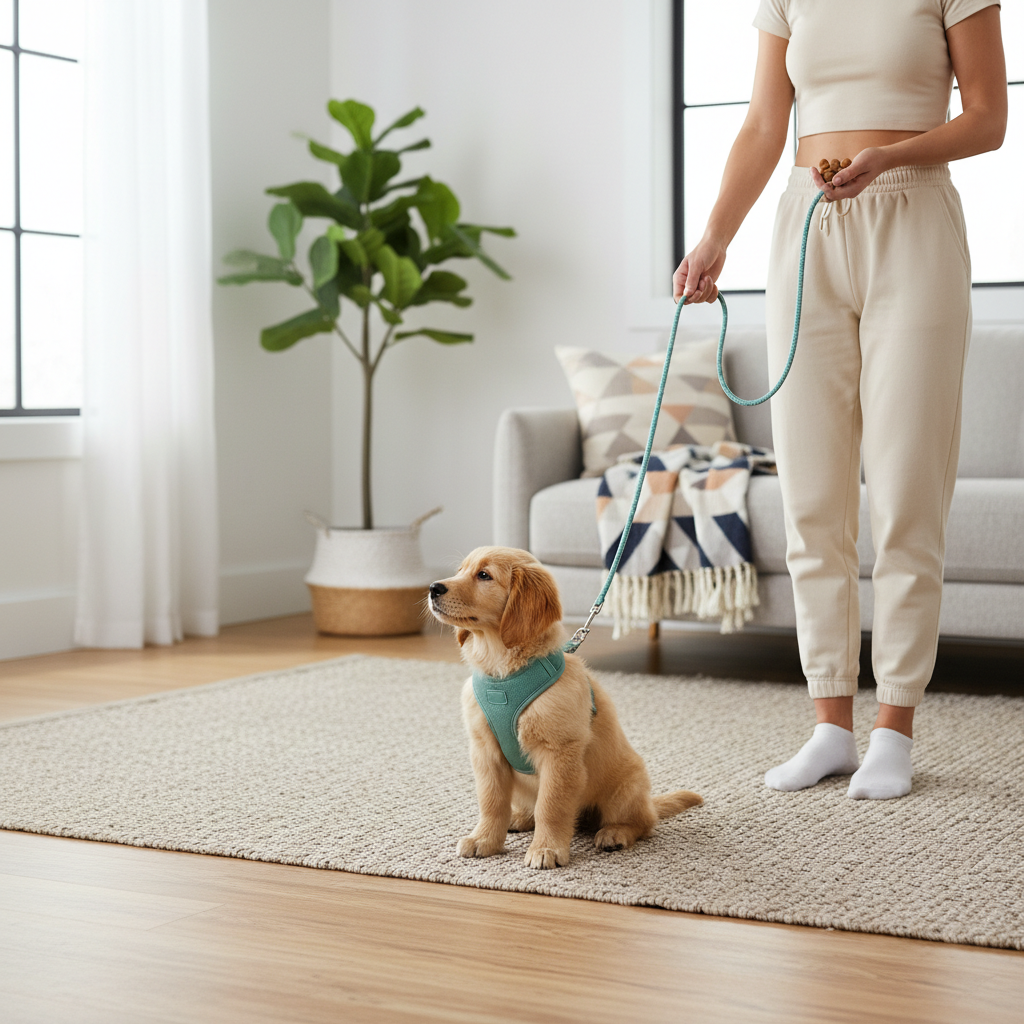
What “leash trained” actually looks like (and what it doesn’t)
A leash-trained puppy is not a puppy who never pulls. It’s a puppy who can reorient to you, understands how to earn progress, and recovers quickly when something exciting happens.
- Realistic goal: the leash stays mostly loose, your puppy checks in often, and you can stop or turn without a fight.
- Not the goal: perfect heel position for an entire neighborhood loop, especially in the first few months.
According to the American Kennel Club (AKC)... early training works best when it’s positive, short, and consistent. For leash work, that usually means a few minutes at a time, multiple times per day, rather than one long “walk” that turns stressful.
Why puppies pull, freeze, or bite the leash
Most leash problems come from a mismatch between puppy instincts and the environment. If you know the reason, you stop fighting the symptom.
- Pulling: pulling works. The puppy pulls, they reach the smell, the person, the leaf, reward delivered.
- Freezing: the leash adds pressure, the world feels big, or the puppy hasn’t generalized “walking with you” beyond the kitchen.
- Leash biting: excitement, frustration, or the leash moving like a toy. Sometimes teething makes it worse.
- Zooming and spinning: overstimulation, too long outside, or too much freedom too soon.
- “Perfect inside, wild outside”: outdoors has higher distractions, your treats and timing have to level up too.
One more thing people don’t love hearing, a puppy who’s under-slept or under-enriched often looks “untrained” on leash, when the real issue is bandwidth.
Quick self-check: which leash plan fits your puppy today?
Use this to decide where to start. You can be honest here, it saves time.
- If your puppy freezes when you clip the leash or steps outside, start with indoor comfort and confidence sessions.
- If your puppy pulls nonstop but seems happy and bold, start with stop-and-go plus reward for check-ins.
- If your puppy bites the leash within 30 seconds, add a management fix (chew replacement) and lower arousal.
- If your puppy panics (trembling, trying to flee, tucked tail), pause neighborhood walks and consider professional guidance.
According to the American Veterinary Society of Animal Behavior (AVSAB)... early socialization should be done carefully and positively, and fear responses deserve extra caution. If your puppy seems genuinely scared, it’s often smarter to build comfort first than to “push through.”
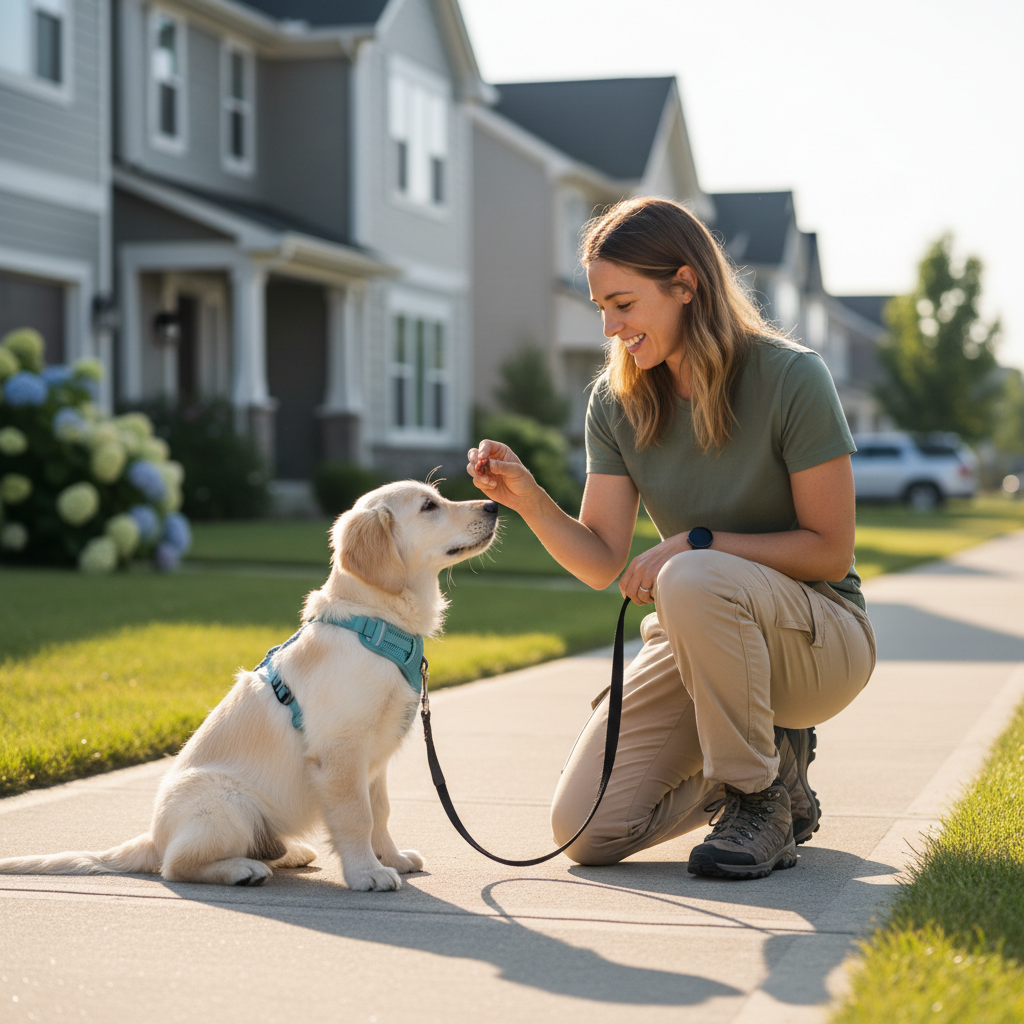
Gear that helps (and gear that quietly makes it harder)
Equipment won’t “train” your puppy, but it can make learning easier or accidentally reinforce pulling. Comfort and safety matter too.
Recommended in many cases
- Y-shaped harness (freedom at shoulders), fitted so it doesn’t rub, you should be able to fit two fingers under straps.
- 6-foot leash for training, not retractable. A standard leash gives clearer feedback and fewer sudden jolts.
- Treat pouch or pockets you can access fast, timing is basically the whole game.
Use with caution
- Retractable leashes: often teach constant tension and can be risky around people, dogs, and traffic.
- Slip leads and corrective tools: may increase fear or frustration for some puppies, and fit/handling errors are common. If you’re considering them, it’s worth consulting a qualified trainer.
According to the Humane Society of the United States (HSUS)... positive reinforcement is a preferred approach for teaching behaviors, especially for young dogs. In practice, that usually means you set the environment up so your puppy can succeed, then pay for the choices you want.
Step-by-step: how to train a puppy to walk on leash without a power struggle
Think of this as three layers, indoor habits, low-distraction outdoor reps, then “real world” walks. You move up a layer when the leash stays loose most of the time.
1) Teach leash comfort (indoors, 2–5 minutes)
- Clip leash, drop it, and feed a treat for calm behavior.
- Let the puppy drag the leash briefly while supervised, reward when they ignore it.
- If leash biting starts, go still, offer a chew or treat scatter, then resume when calm.
2) Teach “follow me” and check-ins (hallway or backyard)
- Take one step, if the leash stays slack, mark with “yes” and treat by your leg.
- Turn often, reward when the puppy turns with you. This builds attention without saying “heel” 50 times.
- Keep sessions short enough that your puppy ends wanting more.
3) Teach the loose-leash rule (outside, low distractions)
- Start with a simple rule: leash tight = we stop, leash loose = we go.
- The moment your puppy hits the end of the leash, stop, say nothing, wait for slack, then move again.
- If waiting creates frustration, turn 180 degrees and reward when the puppy catches up with slack.
4) Add permission-based sniffing (because sniffing is a reward)
- When your puppy walks nicely for a few steps, say “go sniff” and walk them to a spot.
- This turns the environment into your reinforcer instead of your competitor.
This is where a lot of people feel stuck, because it looks slow. But for many puppies, clarity beats speed, and the pace picks up after a few days of consistent reps.
A simple 2-week practice plan (with a table)
You can adapt this, but don’t skip the “easy reps.” Most leash skills fall apart when puppies only practice during high-distraction neighborhood walks.
| Days | Focus | Daily time | Success marker |
|---|---|---|---|
| 1–3 | Leash comfort indoors | 2–3 sessions, 3–5 min | Minimal leash biting, calm clipping |
| 4–7 | Follow + check-ins in low distraction area | 2 sessions, 5–7 min | Turns with you, frequent eye contact |
| 8–10 | Loose-leash rule outside (quiet route) | 1–2 sessions, 8–10 min | Stops/turns reduce pulling within minutes |
| 11–14 | Add distractions gradually + “go sniff” reward | 10–15 min | Recovers from distractions, leash slack returns |
If you only have time for one thing, do three minutes of practice before the walk. That small warm-up changes the whole vibe for many puppies.
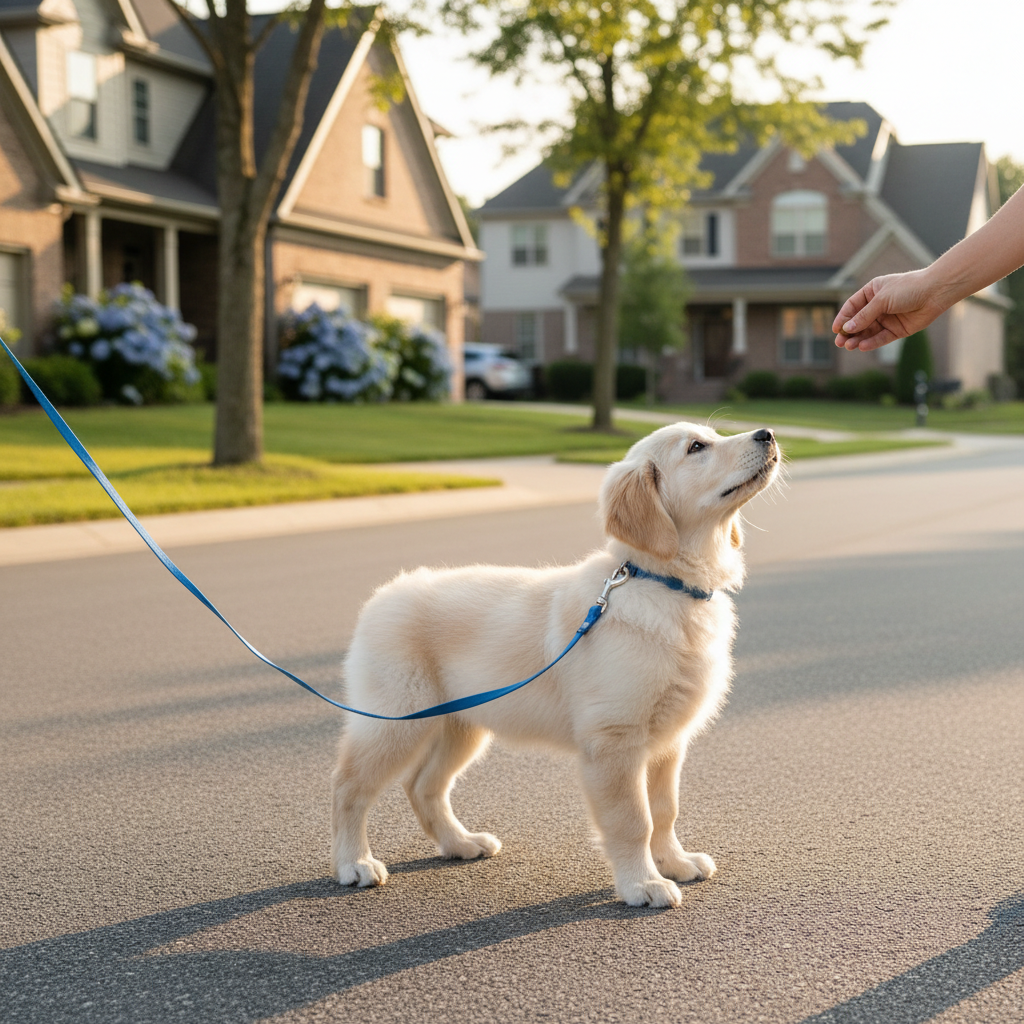
Troubleshooting common problems (quick fixes that actually help)
If your puppy pulls harder when you stop
- Make the environment easier, choose a calmer route or walk at quieter times.
- Switch from “stand still” to a gentle U-turn, movement can lower frustration.
- Increase reinforcement rate for slack leash, pay more often at the start.
If your puppy bites the leash nonstop
- Bring a soft tug toy or chew, give it before the biting starts when possible.
- Avoid yanking the leash away, it often turns into a game.
- Try treat scatters on the ground, sniffing and chewing can help regulate arousal.
If your puppy won’t move outside
- Start in a threshold zone, front porch or driveway, reward one step at a time.
- Use higher-value food, tiny pieces, rapid delivery, then end early on a win.
- If fear looks intense, consider a trainer who specializes in fear-free methods.
If your puppy lunges at people or dogs
- Create distance fast, cross the street or step behind a car, then reward calm looking.
- Skip greetings for now, many puppies don’t need “say hi” practice, they need neutrality.
- If this escalates, it’s reasonable to get professional help early.
Key points to keep walks safe and keep training honest
- Keep sessions short: many puppies learn more in 5 minutes than in a 40-minute overstimulating loop.
- Reward what you want: slack leash, check-ins, turning with you, not just “being near you.”
- Don’t flood your puppy: busy streets, barking-dog fences, and crowded parks can be too much early on.
- Watch heat and surfaces: hot pavement and extreme weather can be risky, when in doubt ask your veterinarian.
- Pair walks with decompression: sniff time, gentle play, and naps reduce “wild leash” days.
If you’re trying how to train a puppy to walk on leash and progress feels random, it’s usually not random, it’s distraction level, sleep, and reinforcement timing showing up all at once.
Conclusion: make it easy to be right, and your puppy will repeat it
How to train a puppy to walk on leash comes down to clear rules your puppy can understand, rewards that matter to them, and practice in places where they can actually succeed.
Pick one quiet route for a week, keep a handful of treats ready, and commit to short reps that end before your puppy melts down, you’ll usually see the leash loosen up faster than you expect.
If your puppy shows strong fear, intense reactivity, or you feel unsafe handling them, it’s smart to loop in a certified trainer or your veterinarian, getting eyes on the problem early can prevent months of frustration.